Another round up of anything new, or new to me, that I interacted with in the past few months. You may notice Heated Rivalry is noticably absent, and that is because I have another topic I want to use that show to explore so expect that to come up a bit later. In this installment, I’ll talk about Frankenstein, Wake Up Dead Man!, and A Christmas Prince series. An odd bunch, to be sure, but notable in their own ways. Some good, some… meh.
(Image source: USM Free Press)
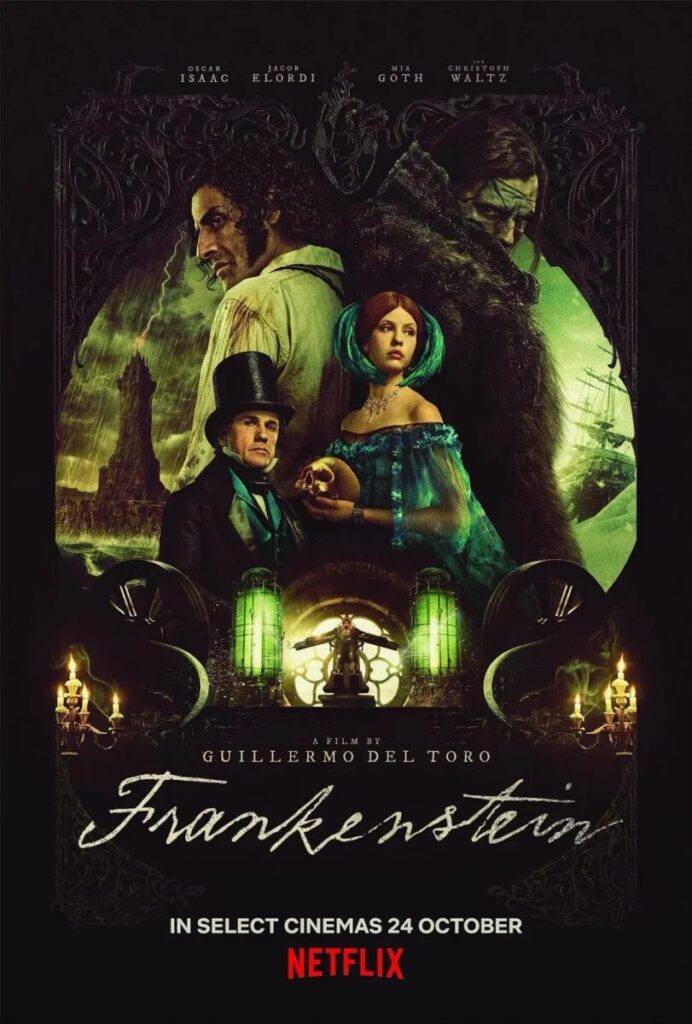
Frankenstein (2025) dir. Guilllermo Del Toro
Del Toro’s adaptation of Mary Shelley’s Frankenstein is a fantastic story. It’s like watching a Greek tragedy in that, as always, the hubris of man is the protagonist’s downfall. Victor Frankenstein, a scientist with a grotesque interest in creating a facsimile of life from corpses, brings us along for the tale of how his experiences as a child led him to create the Creature, and then (true to the book) we get to hear the Creature’s side of the story. In this well-woven tale that explores the challenges and morality of creating life, Del Toro explores Victor’s egotistical desire to control the creation of a life and the struggle with what comes after.
Oscar Isaac plays an unhinged Victor Frankenstein, carrying the audience through the audacity of a man who sees himself as a genius up until the point where he realizes he has no idea how to raise a life and care for it. Jacob Elordi’s physicality as the Creature is especially impressive in this film, with all the awkwardness and delicateness of a seven foot tall toddler. Mia Goth portrays both Elizabeth and Victor’s mother (with some prosthetics to alter her face for the latter role) beautifully. Elizabeth comes off as a perfect foil to Victor in this film, as someone who cares for life even to the smallest creatures.
I had the pleasure of watching this film at the VIFF Center in Vancouver and it was an incredible experience to see all the sets on the big screen. So much care and detail was put into the visuals of this film to bring this gothic myth to life. The colours and cinematography were a joy, especially after years of the boring washed out Netflix lighting audiences have been subjected to, and noticing where certain colours reappeared was a fun puzzle to put together after the film. The greens and blues of Elizabeth’s dresses often resembled the insects that she was so fond of, the red of Victor’s scarf and gloves being reminiscent of his mother, and the way these complementary colours show opposing ideals within the film was well-handled.
I’ve seen many critiques of this film, and I’ve disagreed with many. I’ll talk about those until I get to the ones I agree with.
The first critique I often see pop up is about the decision to end the film with a quote from Lord Byron: “And thus the heart will break, yet brokenly live on.” The reason for this criticism is that many believe the novel to be a criticism of Byron himself and the conceitedness he exhibited in his life. I believe that we are looking at Byron and Mary Shelley’s relationship with a very modern, black and white lens here however. The truth is, for all Shelley’s criticisms of Byron, the two were friends and when he passed on she wrote about him rather lovingly. They had known each other for a long time and ran in similar writer’s circles. Their relationship may be complicated, and that’s fine, but they were connected and I don’t believe choosing a quote from Byron is in and of itself a bad decision. I think there may have been better choices for an end quote, but this doesn’t take away from my enjoyment of the film as much as it seems to for certain other viewers.
One of my least favourite criticisms to see of any piece of media is that the film was not faithful to the source material. I feel, personally, that if I want to read Mary Shelley’s Frankenstein, I will read it (and I do plan to.) An adaptation does not need to be a one to one comparison in terms of story beats. If that was the case, the audience would always know what to expect. Del Toro’s Frankenstein conveys the same themes as Shelley’s novel in a way that is true to his creative vision, and this is a perfectly valid way of adapting a story. The soul of the story remains. What I do not like is when the pieces of a story are used to tell a new story with completely opposite themes, in an attempt to completely subvert the original message in service of some sort of capitalistic agenda. If it is changed for genuine creativity and all the pieces still come together to tell a good story, then I am not personally bothered.
Now, onto a couple critiques I do share. One is that I do feel Del Toro may not have left enough room for nuance while allowing the Creature to also have faults and act out aggressively. In the novel, from my understanding, there are times where he acts maliciously and hurts others. I understand and agree with Del Toro’s broad theme that persists throughout his works, that the monsters are often nowhere near as monstrous as a man can be, but I think allowing the Creature to have a moment of acting in malice would have helped build up the themes, especially since the Creature is essentially portrayed as a newborn, then a toddler, before he is finally reading complex literature and becomes essentially an adult. The toddler phase of life is often best portrayed by accidental harm: destroying your own toys and learning that your actions have consequences that you at times may not prefer, killing a small creature like an insect (which may have played well against Elizabeth’s interests) and beginning to understand that you are taking a life. These are all things that would have been interesting to explore in the themes of this story, but didn’t quite have a home within the runtime. I can understand why the film might have been tight to edit already, but it would have been a nice addition.
I also felt that, though Oscar Isaac carried the role well, Victor’s heartlessness became somewhat cartoonish the longer the film went on. It became harder and harder to relate to his indifference to the Creature, particularly given how it ends, and this fact removed Victor somewhat from the very real comparison that is attempted to be made to real men that inhabit the same role as Victor in our modern life, whether you want to see him as a slighted man becoming a father, the tech bros who create products that they unleash on the public without ensuring they’re good for the world, or a heartless god who cares not for his subjects. Choosing when Victor shows compassion may also help it become clearer as to what he is meant to be an analog for.
Overall, I enjoyed the film quite heartily. It has a few faults, but I enjoyed the experience of watching it.
(Image source: IMDB)
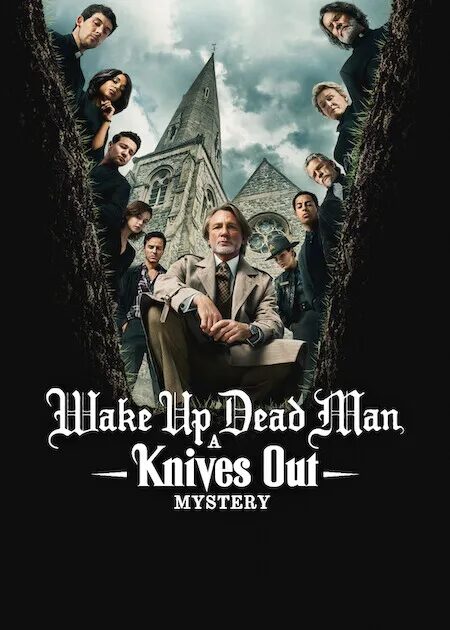
Wake Up Dead Man: A Knives Out Mystery (2025) dir. Rian Johnson
The third film which completes the Knives Out trilogy stands a bit further into the darkness than previous entries, figuratively and literally, but it is a film that is crafted with the complexity that the themes demand. In this film, I see a story playing out that will likely feel familiar to a certain extent to nearly everyone, given the themes of religion and faith, which most of us grow up with in our lives in some way or another.
The murder mystery of this film had me genuinely perplexed at many points of the film and, when it all came together at the end, it was one of the most satisfying moments of the entire series. When even Benoit Blanc calls the mystery “impossible,” you know you’re in for something absolutely insane.
This instalment follows Father Jud, a former boxer who is now pursuing the priesthood while seeking spiritual atonement for a grievous sin he committed: ending a man’s life in the ring, knowingly and with anger in his heart. From the moment we meet Father Jud, played by the gentle-eyed Josh O’Connor, you get immediate cues as to his past from the neck tattoo peeking above his collar to the way he still seeks out physical outlets for his emotions. Father Jud is also a fantastic analog for viewers as he is an imperfect person. If we are all sinners because it is impossible to live a sin free life, then who better to guide us through this story than a priest who has a dark past? The story begins with Father Jud being reassigned to a church in upstate New York, which is currently run by the tyrannical and ultra conservative Monsignor Wicks, played by Josh Brolin. As he gets to know all the members of the parish, the mystery of the past of Our Lady of Perpetual Grace begins to unfold itself up until the expected murder of the murder mystery.
The themes of religion are used in such a masterful way. I think regardless of whether you lean towards or away from religion, the scene where Father Jud speaks on the phone with a woman named Louise, whom he calls for information related to the case, is a gut punch. A major tonal shift occurs from Louise at first seeming like a bumbling and distracted receptionist to suddenly, realizing the opportunity she has while on a call with a priest, pivoting to a serious tone as she confesses a heart-wrenching fear and asks for Father Jud to pray for her. It is a sobering moment for him as a character, realizing he has been so wrapped up in the case that he has momentarily forgotten his calling and what really matters in life, and it is also a reminder of the societal importance of his services. Regardless of a viewer’s feelings towards religion, we can all agree that bringing someone peace in a troubling time is a worthwhile cause.
Another facet of how this theme is explored is through Benoit Blanc’s feelings towards religion. Perhaps it is unsurprising, given in the second film we see that Blanc has a “live-in roommate” played by Hugh Grant whom I think we can safely assume is Blanc’s partner or husband, that Blanc’s feelings towards religion are complex and lean heavily negative. I felt like my own feelings aligned fairly closely with Blanc’s and that made going on this ride through his eyes — although I would describe Jud as the main character in this film — a relatable experience. Blanc has moments where his critiques of religion are proven true, and moments where he is reminded of why some may continue in the faith.
This was a fitting end to the Knives Out series, even though I certainly wish we could see Benoit Blanc solve more murders. Each film tackles an interesting topic as the mystery is worked through, and tackling religion given the current political climate feels like a smart move. For those who felt Glass Onion was too obvious with its themes, I feel like this film is equally obvious but perhaps less forceful. Personally, I enjoyed Glass Onion equally as the other two films, but I could see why some may not enjoy it. Regardless, I definitely recommend returning to the series for this installment.
(Image Source: Rotten Tomatoes)
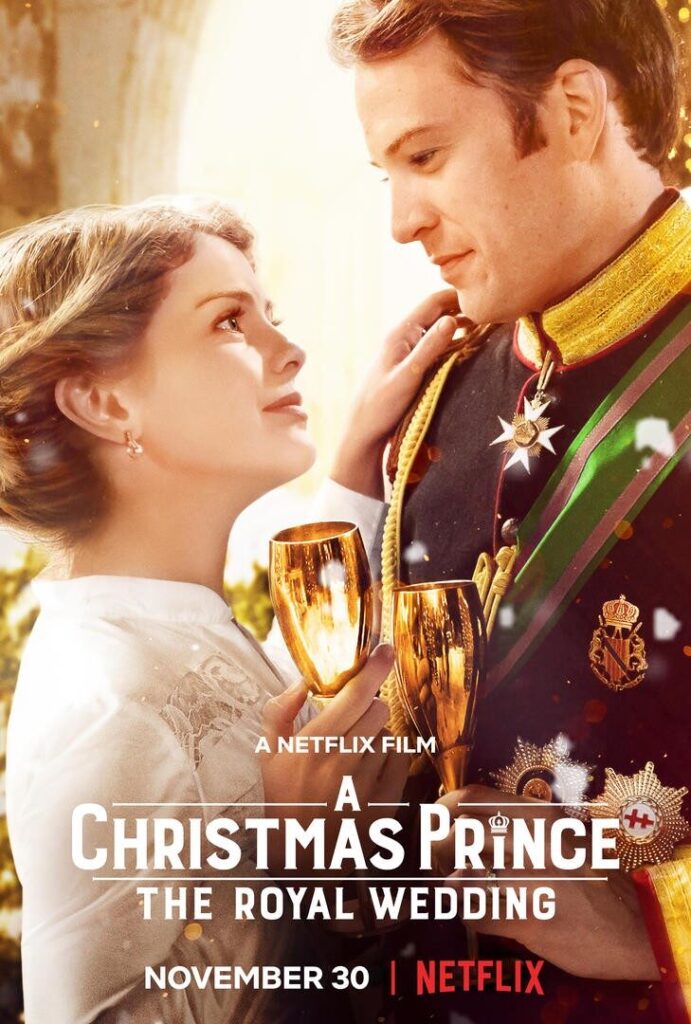
A Christmas Prince: The Royal Wedding (2018) and A Christmas Prince: The Royal Baby (2019) dir. John Schultz
Bad Christmas movies have quickly become a tradition for my partner and I. We can’t get enough of ‘em. The sloppier the better. And few things are sloppier than the Christmas Prince series. Nothing can prepare you for how impressively bland these films are. Belonging to the film category of Netflix Christmas Slop (thank you Big Joel), the Christmas Prince series follows a journalist who falls in love with the prince of a small country called Aldovia. Now that the two have fallen in love, we follow the natural progression: “First comes love, then comes marriage, then comes a baby in a baby carriage.”
A Christmas Prince: The Royal Wedding is a film about the struggles of expectations when marrying into a royal family. Amber, our female protagonist, is still blogging away about her life as a soon-to-be princess — which, after watching Harry and Meghan (2022), I’m honestly surprised she is allowed to do, but it only becomes an issue late into the film. Between all the rules and rituals and strong personalities, Amber is feeling like she has no control over her own wedding. This in turn puts strain on her relationship with Richard, the eponymous prince of the story. To top off all the wedding drama, Richard is also dealing with unease in the kingdom, where workers are struggling to get enough work and pay to even celebrate Christmas. Finally, Amber takes it upon herself to investigate the cause of the financial stress in Aldovia and, after some hardcore™ hacking discovers that a larger company has been taking over the smaller ones that most of the town worked for. They right the wrong, and have a beautiful wedding, and we have yet another happy ever after. High five, team.
The third film, A Christmas Prince: The Royal Baby jumps a year ahead to the next Christmas, where Amber is now an expecting mother. This film worked the hardest to maintain a timeline, showing the date whenever a scene changed over to a new day, and yet somehow it is the one my brain remembers the least. There was another kingdom visiting Aldovia, they had to make a deal together, something something. It doesn’t matter. What does matter is that this is one of the most stressful least serious birthing scenes I’ve ever seen. It’s the definition of one moment the baby’s inside her, the next it’s out and her stomach is immediately flat. And she manages to solve the problem while in active labour. Because of course she does.
This series is exactly the kind of Christmas slop that’ll make you want to play a drinking game as you watch. Pour yourself some eggnog with a hearty shot of rum. The main actors have no chemistry with each other, the plot is loose and ridiculous, and the jokes are cheesy as hell. Enjoy!